
Mount Pleasant City Directory Holdings
Mount Pleasant city directories sit in a local research shelf rather than in one complete online run. The NPS downtown historic-district bibliography identifies directory years from 1925-26 through 1998, with gaps. CRDL points researchers to directories, local newspapers on microfilm, yearbooks, cemetery resources, and the obituary index. Clarke Historical Library, the Library of Michigan, and the 1930 Luedders community archive add other routes. Check the holding and edition before assuming a directory covers the whole city or every household.
| Collection | Years | Where held | Access |
|---|---|---|---|
| Mount Pleasant directory bibliography | 1925-26 through 1998, with gaps | NPS downtown historic-district documentation and local institutional holdings. | Use the bibliography to identify an edition, then confirm the holding with the library or archive. |
| Luedders Historical and Pictorial City Directory | October 1930 | Community genealogy archive for Mount Pleasant. | Online alphabetical, street, and classified navigation. |
| Polk and Bresser directory patterns | Polk late-1800s and Bresser late-1960s patterns in the state guide | Library of Michigan and participating print, microfilm, fiche, Ancestry Library Edition, or HeritageQuest holdings. | Access depends on the particular holding and any library authentication. |
| CRDL and Clarke local-history sources | Newspapers and obituary index, with CRDL index reported 1875-present | Chippewa River District Library, Clarke, and Veterans Memorial Library paths. | Database, microfilm, library, or archive route depending on the item. |
The gaps are important. A missing year can mean the edition was not held, was not published, has not been digitized, or has not been located in the inspected sources. The absence of a name has the same limits, especially when a directory was selective or a scan has weak OCR.
Map Mount Pleasant City Directory Years
The NPS bibliography provides a practical timeline for matching an address to an edition. It lists 1925-26, 1928-29, 1930, 1932-33, 1934, 1936, 1939-40, 1941-42, 1943-44, 1945-46, 1947-48, 1949-50, 1953, 1958, 1960, 1962, 1963, 1966, 1968, 1970 through 1973, 1975, 1976, 1978, 1980, 1981, 1983 through 1990, 1992, and 1998. These dates establish known local editions, not a claim of continuous publication.
| 1925-26 onward | The local bibliography begins with a documented run of interwar and later directory editions. |
|---|---|
| 1930 | Luedders is specifically named and is available through a local genealogy archive. |
| Late 1960s pattern | The Library of Michigan guide describes Bresser criss-cross arrangements, subject to the edition held. |
| 1998 | The last year named in the inspected NPS bibliography, not proof that no later directory exists. |
Pair a directory year with the closest federal or state census material only as a historical comparison. Isabella County's record history includes federal census from 1870, state census years 1884 and 1894, and a special Mount Pleasant census in 1976. Their boundaries and indexing systems may not match a later city address.
Read the 1930 Mount Pleasant Directory
Luedders' Historical and Pictorial City Directory of Mt. Pleasant Michigan states that it contains a city canvass, family names, a street directory, classified businesses, public officers, and taxpayer material for named townships. The source is especially useful because it gives both alphabetical and street paths. It is a historical local genealogy source, not a current government directory. The archive's captured text did not reliably expose a complete individual entry, so a transcription should not be quoted as though the original entry had been independently inspected.
Luedders' 1930 Mount Pleasant directory archive supplies the historical street, alphabetical, classified, and abbreviation navigation.
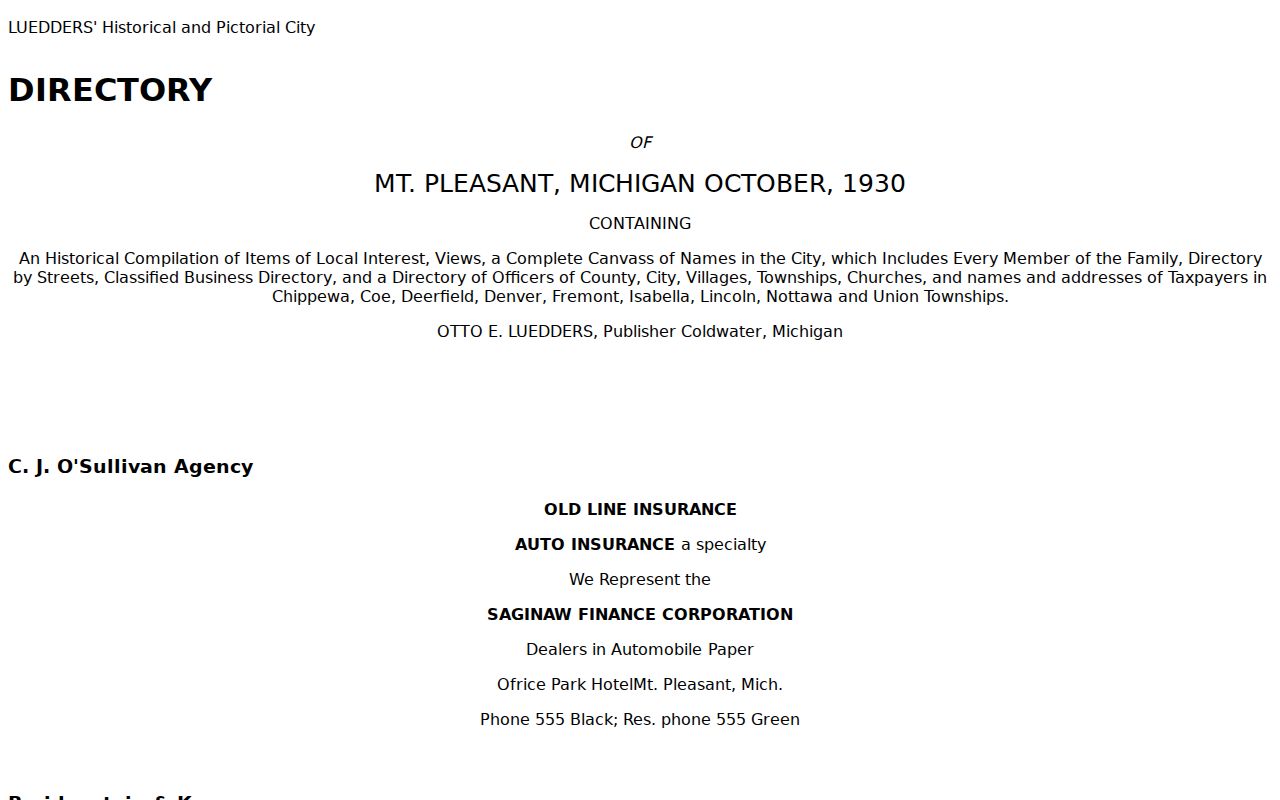
Use the edition and page or scan reference with any note. A 1930 street listing can support a dated address question, while the surrounding classified and officer material can reveal the local setting. It cannot establish a current address or a legal property interest.
Read a Mount Pleasant City Directory Entry
Each directory has its own legend. The Library of Michigan guide says Polk directories may be organized by surname, street, phone, and classified section, and entries can show occupation, other household members, and owner or renter status. Bresser criss-cross directories can show street or address, head of household, phone, owner or renter status, first year listed, and new-arrival or relocation clues. Use only fields that the edition actually prints, and photograph or copy the abbreviation key before interpreting marks.
| Name | May identify a household contact, a person in an alphabetical listing, or a business connection. |
|---|---|
| Street or address | Places the entry in that edition. Compare spelling and numbering with the year printed. |
| Occupation or classification | May supply a role, employer, business category, or organization lead when the volume includes it. |
| Household notation | Some editions show other household members, spouse information, owner or renter notation, or a phone. |
| Edition key | Controls abbreviations, symbols, and the scope of the listing. Do not import meanings from another publisher. |
- Criss-cross directory
- A street-order section that begins with an address and may identify the head of household or related directory fields.
- Householder index
- An arrangement that points from a household name to an address or another entry path in the volume.
- Abbreviation key
- The publisher's explanation of symbols and shortened terms. It should be read before relying on an owner, renter, or relationship mark.
Compare Mount Pleasant Directory Formats
Polk and Bresser volumes invite different reading habits. A surname-first Polk entry can lead to a street and then a classified or phone section. A Bresser criss-cross route can start with a street and move back to a head of household. Neither format makes a directory a deed. The Mount Pleasant street directory is the better route when a current parcel, map, legal description, or recorded instrument is the question.
The state directory guide identifies print, microfilm or fiche, Ancestry Library Edition, and HeritageQuest as possible formats depending on the holding. Begin by asking the library which format and years are available. When viewing an image, retain the edition, publisher, page, and exact section. A surname can be misspelled, a street can be renumbered, and smaller-city coverage can be irregular.
Note: A city-directory finding is strongest when the exact edition, page, and publisher are saved beside the name and address.
Use Mount Pleasant Libraries for Directory Leads
CRDL's genealogy and local-history resources point to city directories, books and periodicals, local newspapers on microfilm, yearbooks, cemetery material, the obituary index, Clarke Historical Library, and the Digital Michigan Newspaper Portal. Its obituary index is reported to begin in 1875 and run to the present. An obituary can connect a directory name to relatives, a cemetery, an event date, or an organization, but it is not a certified vital record or proof of ownership.
Chippewa River District Library genealogy and local history gathers the local research paths, including its directory and obituary leads.
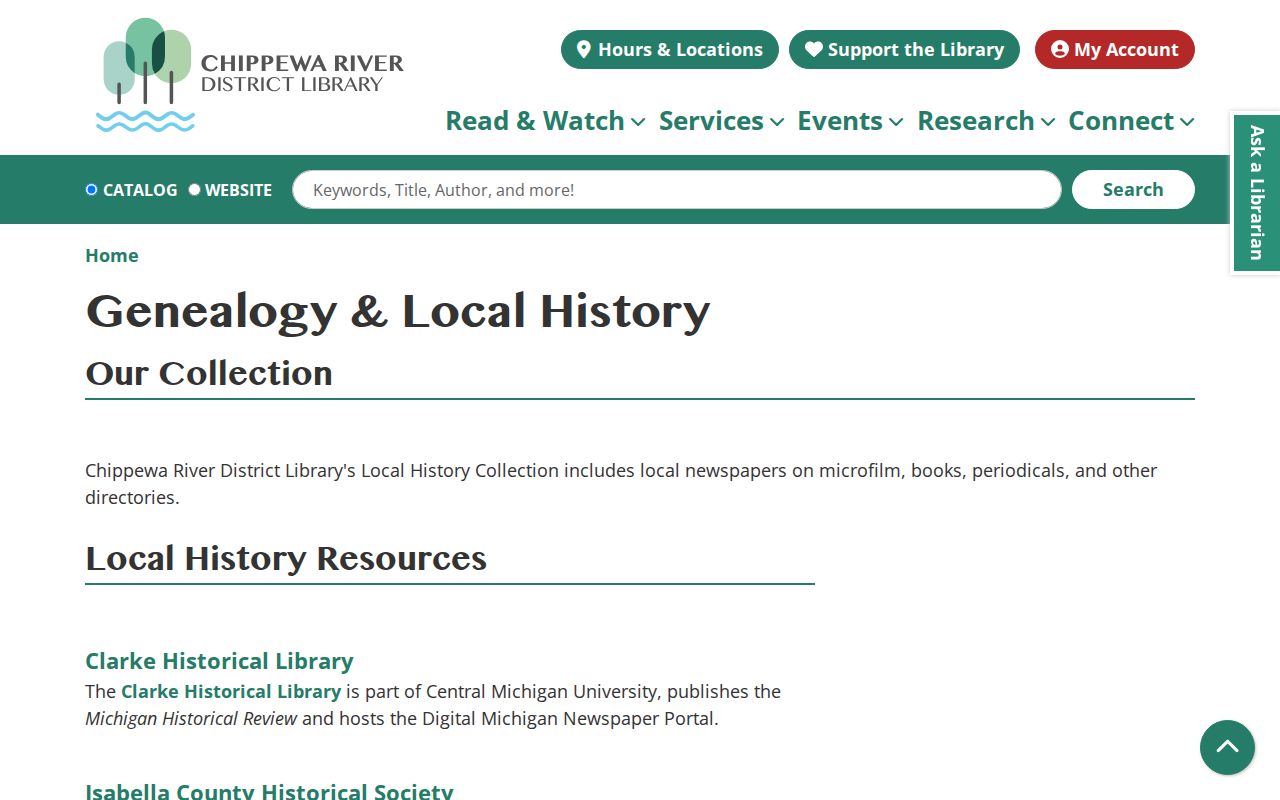
The library route matters when the useful item is on microfilm or inside a database rather than on an open web page. Follow a directory lead into the original newspaper image when possible, then separate what the notice says from what a civil record can certify.
Clarke Historical Library's Isabella County history resources describe the digitized obituary index and the institutional path to microfilm-indexed papers at Clarke and Veterans Memorial Library.
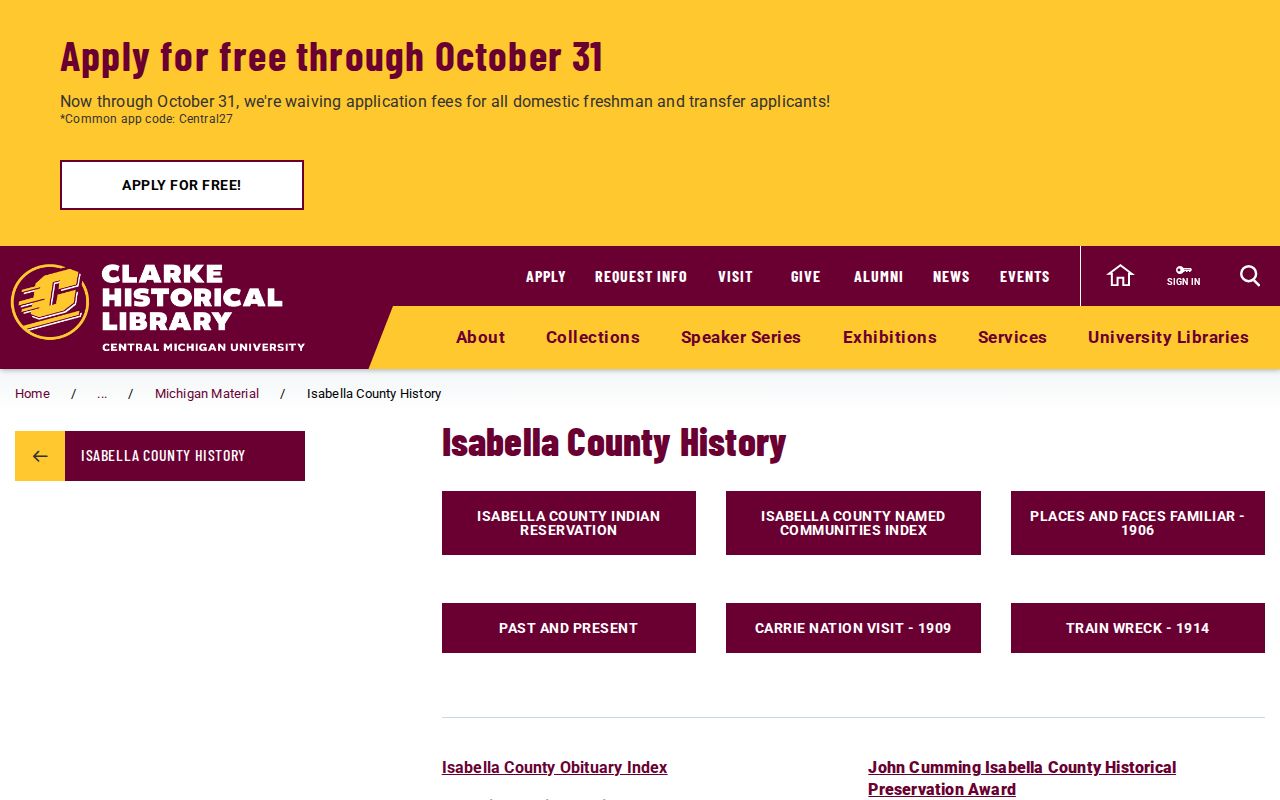
That institutional chain is useful when a search engine cannot see a page or when an OCR hit needs image verification. Ask staff about the edition, reel, collection, or index path rather than assuming every cited item has a public scan.
Connect Mount Pleasant Directories to Newspapers
Newspapers can explain the move, school connection, business, fire, church, or civic event behind a directory entry. The Mount Pleasant local newspaper archive reports more than 12,000 pages across six local papers, chiefly 1956-1996 with some 1930s material. It supports searching, viewing, printing, clipping, saving, sharing, and browsing. Search a surname with a place or event term, and try OCR variants rather than relying on one spelling.
Mount Pleasant's local newspaper digital archive describes its searchable local title and date coverage.
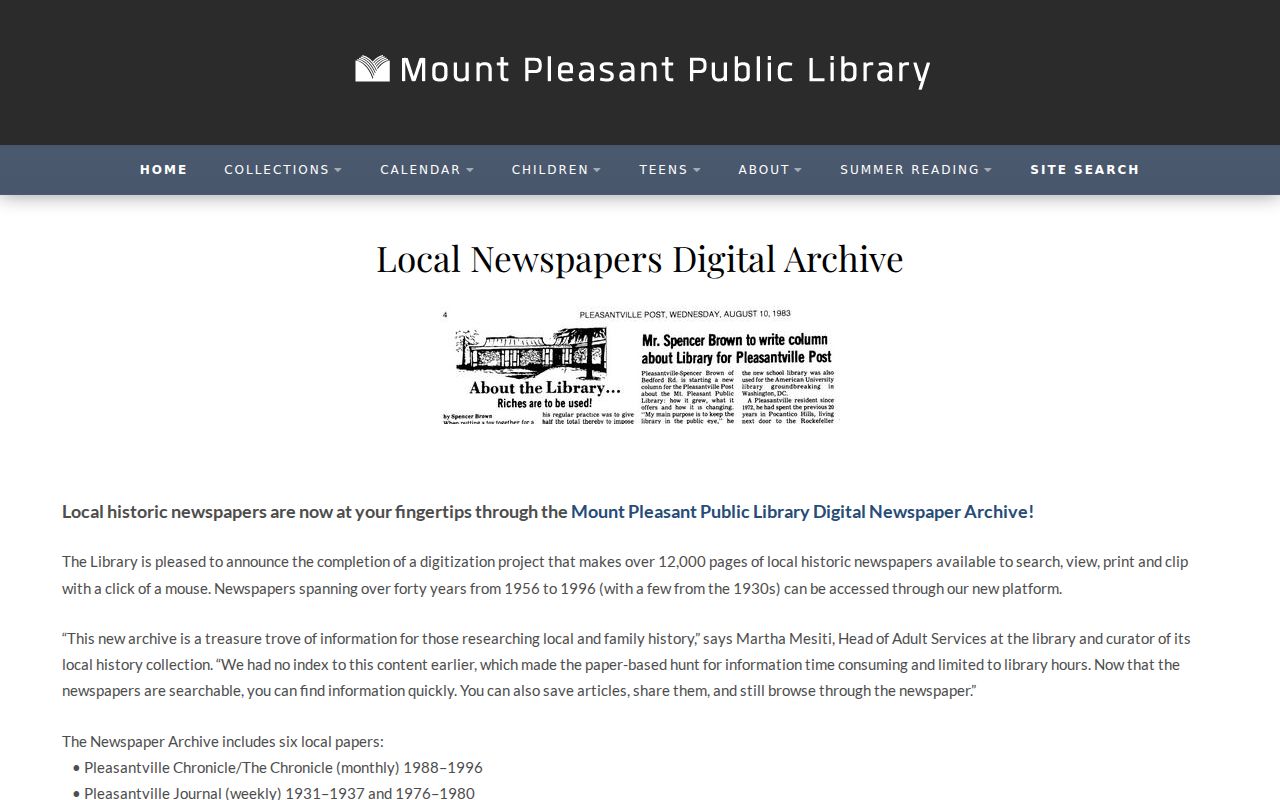
The archive can bridge the years between directory editions, but the exact title and date should be retained with any conclusion. Its inspected title list includes Pleasantville Chronicle or The Chronicle, Pleasantville Journal, Pleasantville Post, Saw Mill River Record, and Valhalla Voice; the sixth title was not fully exposed and should be verified before naming it.
Clarke's newspaper digitization and microfilming resources list local runs from Isabella County Enterprise through Central Michigan and later local titles.
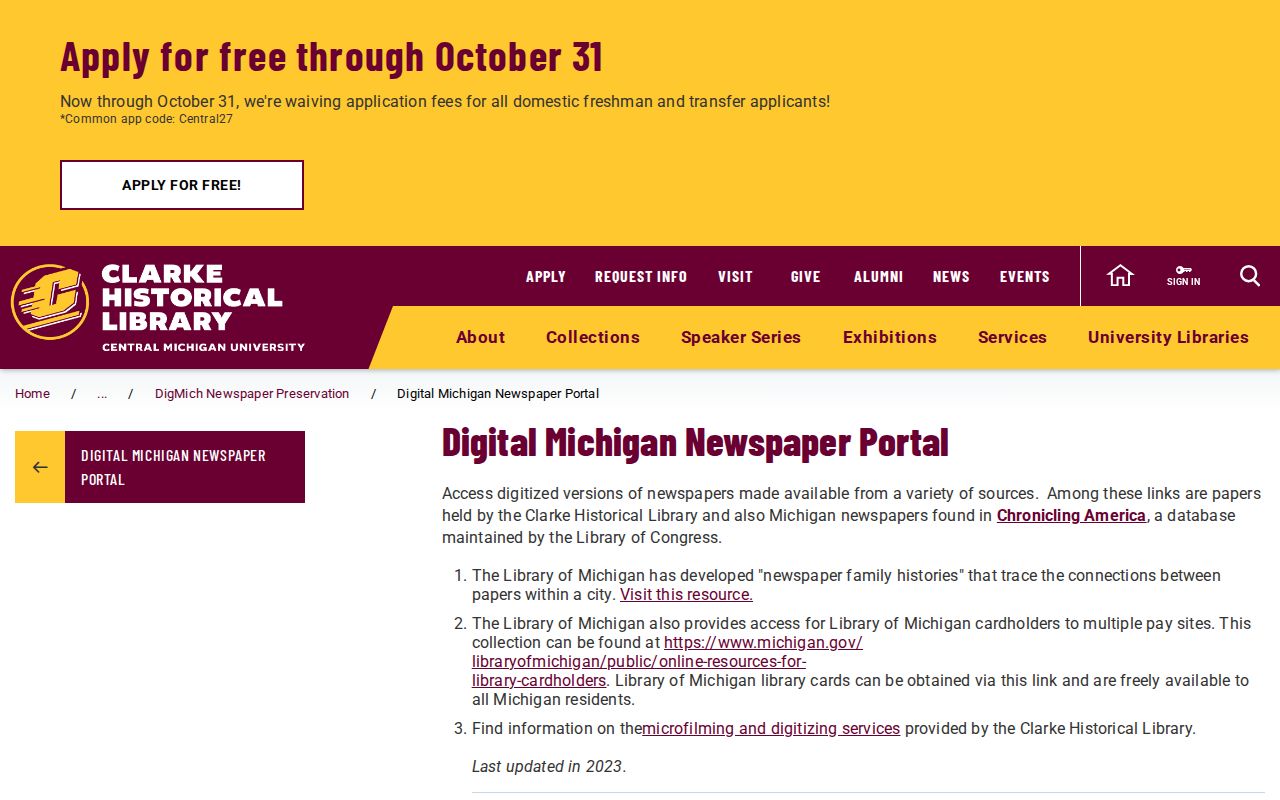
Clarke lists Isabella County Enterprise from 1875-1926, Central Michigan Life from 1941-2019, and many other specific local runs with free, hybrid, or pay access. Choose the title that fits the period and social setting, then inspect the image because OCR can misread historical type and names.
Trace a Mount Pleasant Household Across Editions
A household trail should move through time one source at a time. Start with a known edition and retain the printed spelling, address, and section. Check the next available directory rather than assuming an annual run. Then use a newspaper, obituary index, yearbook, cemetery result, census, or public record that matches the date. The result is a sequence of dated observations, not a single identity profile.
- Locate the first confirmed Mount Pleasant city directory edition for the surname or street, and save the edition and page reference.
- Check the next available local edition for an address, spelling, household, or classification change.
- Use the criss-cross or street section only where the volume provides one, and read its key before interpreting a notation.
- Search a local newspaper by name plus street, school, church, organization, or event. Verify an OCR result against the image.
- Pair a disappearance with the CRDL obituary index, Riverside Cemetery research, or an appropriate civil record path, while keeping each source's limits clear.
A name that vanishes may reflect a move, death, a publishing gap, a changed spelling, a different household arrangement, or selective coverage. Michigan vital records have separate access rules, including restricted birth records under 100 years and broader access for death, marriage, and divorce certified copies. Do not treat a directory absence as a legal finding.
Mount Pleasant Fires Change Address Context
Historic events can explain why a directory address looks unfamiliar. The downtown nomination records major fires in 1875, south of Broadway in 1882, and west of Bennett in 1895. Sanborn map years of 1884, 1890, 1895, 1900, 1910, 1924, 1931, and 1950 provide a way to compare a building footprint, materials, use, and street context around those changes. Maps are a building layer, not a list of people.
The 1895 fire also appears in the local library history as the event that destroyed most early Veterans Memorial Library books. A missing early volume may reflect a collection gap rather than a lack of local activity. Search newspapers around rebuilding dates and compare the directory's printed address to the period map before deciding that a household or business moved.
Keep Mount Pleasant Directory Clues in Context
Directory research is strongest when it preserves its source boundaries. A directory can identify a dated listing, a newspaper can add contemporary language, a cemetery tool can identify interment, and a deed can record an instrument. These are not interchangeable. The city reports an interactive Riverside Cemetery burial search and plot map announced in January 2026, but its current field completeness should be checked live. A plot is not evidence of a residence at the time of death.
If a historical directory lead must be checked against a modern person record, use the official custodian appropriate to the record type. A focused Mount Pleasant resident lookup can help distinguish a court, voter, or vital-record path from historical library material. Use only the minimum fields needed for family history, estate research, reconnection, property history, or civic inquiry, and do not assemble sensitive details into a dossier.